
Table of Contents
- What Does Bohemian Mean? Definition and Origins
- Core Values of the Bohemian Lifestyle
- Bohemian Fashion Style: How to Wear It Every Day
- Bohemian vs Hippie Differences: What Sets Them Apart
- Bohemian Home Decor Ideas to Transform Your Space
- Modern Bohemianism: Digital Nomads, Van Life, and Intentional Living
- The Psychological Pull of the Bohemian Mindset
- Conclusion
Last Updated: August 28, 2026
What Does Bohemian Mean? Definition and Origins
Bohemian describes a person who lives an unconventional, creative, and free-spirited life, rejecting mainstream social norms in favor of artistic expression and intellectual freedom. At Loving Life Clothing, we've built our brand around this spirit, the idea that how you dress and move through the world can be a radical act of self-definition. The word carries centuries of history, but its core meaning remains consistent: a Bohemian refuses to let society dictate the terms of their life.
Etymology and the Roma Connection
The word "Bohemian" derives from the French bohémien, which referred to the Roma people who entered Western Europe through the region of Bohemia, now part of the Czech Republic. According to Merriam-Webster's historical etymology records, the term transitioned from a geographic descriptor to a cultural one during the 19th century, when French artists began adopting the Roma's perceived wanderer lifestyle as a romantic ideal. The original Bohemians were a marginalized group whose nomadic existence was born of necessity, not aesthetic choice, a tension between romanticization and reality that runs through Bohemianism's entire history.
Bohemianism in the 19th Century
The Bohemian movement emerged in Paris during the 1830s-1840s, centered around the Latin Quarter's literary circles and artist studios. Henri Murger's 1851 novel Scènes de la vie de bohème crystallized the archetype: the starving artist, the eccentric wanderer, the creative nonconformist who chose freedom over financial security. This counterculture rejected the bourgeoisie's obsession with property, status, and respectability. The movement spread across urban centers in Europe and America, taking root in Greenwich Village, San Francisco's North Beach, and later the Beat Generation of the 1950s.
Core Values of the Bohemian Lifestyle
The real substance of Bohemianism is a value system, not merely an aesthetic. The lifestyle is built on recognizable principles that have remained stable across two centuries:
- Creative freedom above career security
- Intentional living, deliberate choices about time, money, and energy
- Community over competition, shared spaces and mutual support
- Minimalism as liberation, owning less to experience more
- Nonconformity as identity, examining rather than automatically accepting social norms
- Wandering as wisdom, travel and cultural exposure as educational tools
What separates genuine Bohemianism from aesthetic cosplay is commitment to these values in practice. A person can wear flowing linen without being Bohemian in any meaningful sense. The lifestyle is an orientation toward life, not a wardrobe.
Bohemian Fashion Style: How to Wear It Every Day
Bohemian fashion is the visual language of the lifestyle: layered, handcrafted, eclectic, and deeply personal. The goal is to look authentically yourself, not "put together" in the conventional sense.
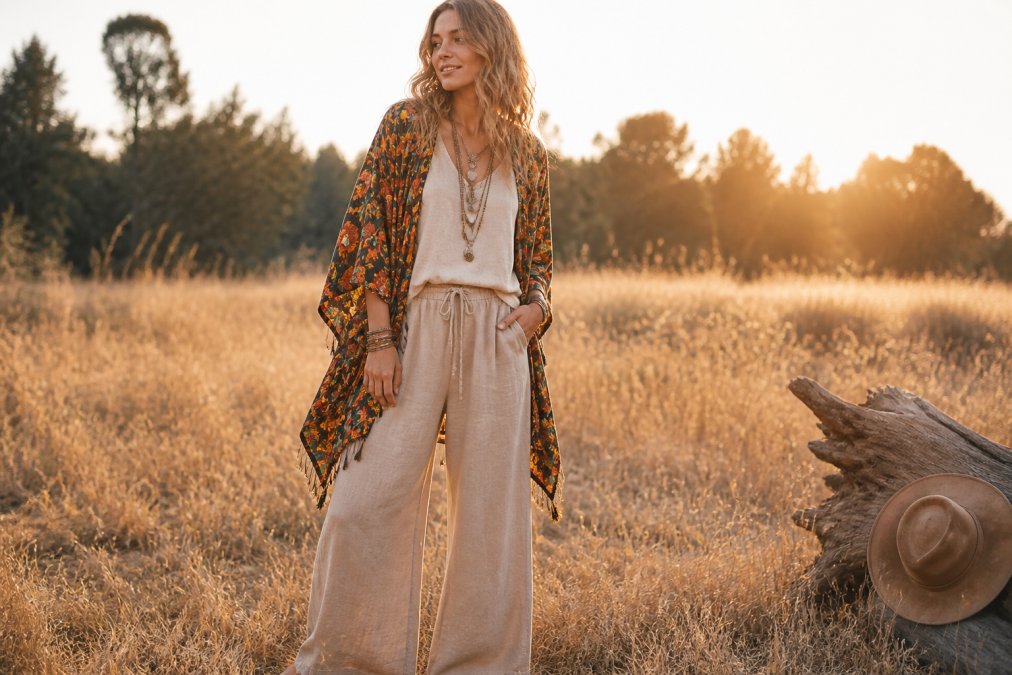
The biggest mistake is treating bohemian fashion like a uniform. It's a framework for self-expression that should evolve with you.
Key Pieces That Define the Aesthetic
The bohemian aesthetic has a recognizable vocabulary:
- Relaxed-fit silhouettes, wide-leg pants, maxi skirts, oversized tops that move with the body
- Hand-dyed and natural textiles, tie-dye, batik, and naturally dyed fabrics
- Layering, multiple textures and lengths worn together
- Earthy and jewel tones, terracotta, mustard, forest green, deep indigo, and rust
- Natural materials, cotton, linen, hemp, and wool
- Statement jewelry, stacked rings, layered necklaces, and beaded bracelets
- Worn-in footwear, leather sandals, ankle boots, or bare feet
The easiest entry point is a single statement piece, a hand-dyed top or floral maxi skirt, paired with basics you already own. For daily wear: loose linen trousers with a tucked-in hand-dyed blouse and leather sandals works for errands and casual meetings. The relaxed fit is key; bohemian clothing should never feel like you're trying.
Bohemian vs Hippie Differences: What Sets Them Apart
The bohemian vs hippie question comes up constantly, and the confusion is understandable. Both share overlapping visual territory, but the roots and philosophy diverge significantly.
Bohemian is a centuries-old cultural identity rooted in artistic and intellectual nonconformity, primarily about creative freedom and living outside conventional structures. It has no specific political agenda and no defined historical moment of origin.
Hippie is a specific counterculture movement that emerged in the mid-1960s as a response to the Vietnam War, racial injustice, and corporate capitalism. It carried explicit political commitments: peace activism, communal living, and back-to-the-land philosophy. As documented in the Smithsonian's cultural history archives, the hippie movement peaked between 1967 and 1972.
| Dimension | Bohemian | Hippie |
|---|---|---|
| Origins | 19th-century Paris artistic circles | 1960s American counterculture |
| Core focus | Creative and intellectual freedom | Political activism and peace |
| Time period | Continuous, ongoing | Peak: 1967-1972 |
| Aesthetic roots | European romanticism, wanderer culture | Psychedelia, Native American influence |
| Political alignment | Not inherently political | Explicitly anti-war, anti-establishment |
| Modern expression | Intentional living, creative economy | Eco-activism, commune living |
All hippies drew from Bohemian values, but not all Bohemians are hippies. The Bohemian is the broader, older archetype.
Bohemian Home Decor Ideas to Transform Your Space
Your living space is an extension of your values. Bohemian home decor centers on creating environments that feel layered, personal, and alive.
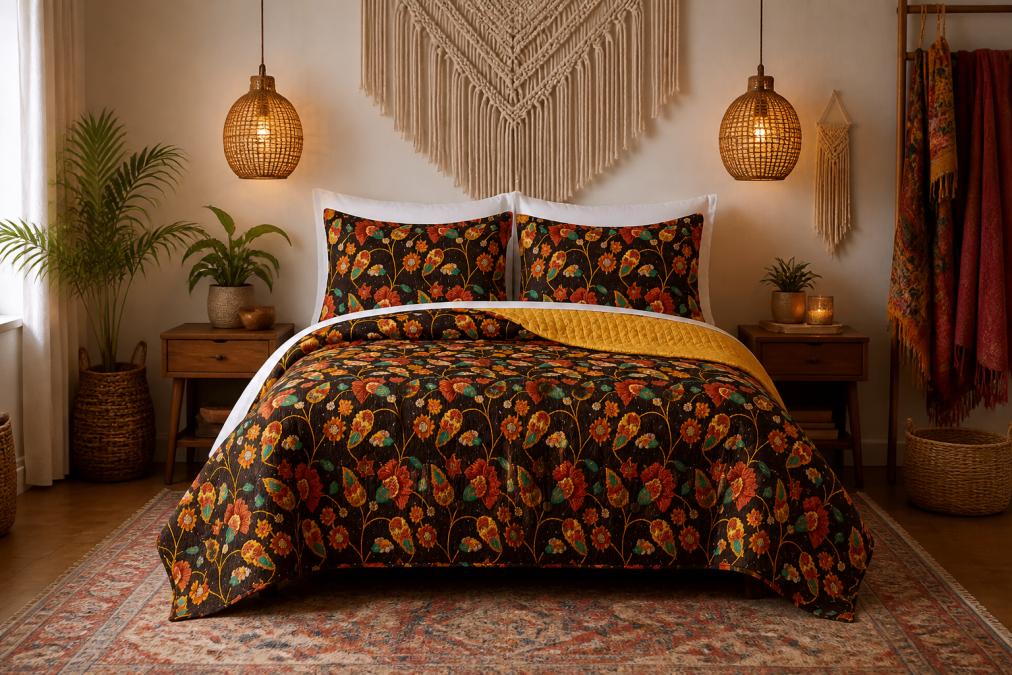
The starting point is textiles. Bohemian spaces are built on layered fabrics, quilts, throws, cushions, and curtains in complementary patterns. Anchor the palette with two or three dominant colors and let patterns vary within that range.
Practical approaches that work:
- Bedding as the centerpiece, A richly patterned quilt sets the tone for the entire room. The DaDa Bedding Marigold's Floral Brown Yellow Botanical Garden Quilted Bedspread Set brings honey yellow, burnt orange, and teal onto a charcoal-black canvas at $43.70.
- Paisley and botanical prints, The visual vocabulary of Bohemian interiors. The DaDalogy Paisley Dreams Floral Bed in a Bag Set in Olive Brown delivers a full coordinated look in warm cottage tones.
- Macrame and woven wall art, Texture on the walls
- Plants, Living greenery is non-negotiable
- Vintage and found objects, Mismatched frames and inherited pieces over mass-produced decor
- Warm lighting, Rattan pendant lamps and candles over overhead fluorescents
The DaDa Bedding Bohemian Purple Blooms Floral Garden Bedspread Set works well in rooms that need brightness without maximalism.


Modern Bohemianism: Digital Nomads, Van Life, and Intentional Living
The most interesting thing about Bohemianism is how cleanly it maps onto contemporary life. The 19th-century Bohemian renting a Paris garret is structurally identical to the 2026 remote worker living in a converted van and earning income through freelance design.
Modern Bohemianism expresses itself through several overlapping movements:
Digital nomadism, location-independent workers treating the world as their workspace. The nomadic ethos of historical Bohemianism maps directly onto this lifestyle, now economically viable at scale.
Van life and alternative housing, tiny homes and off-grid living as deliberate rejection of the mortgage-and-suburb template.
The maker economy, artisans and independent creators selling directly to their communities through hand-dyed clothing and small-batch goods.
Slow travel, extended stays in single locations for immersion rather than destination accumulation.
According to MBO Partners' State of Independence research, independent workers now represent a significant and growing share of the American workforce, many explicitly describing their arrangements in terms echoing Bohemian values: freedom, creativity, and self-direction. The modern Bohemian isn't necessarily poor; intentional living requires deliberate choices about priorities, not poverty.
The Psychological Pull of the Bohemian Mindset
Why does Bohemianism keep attracting people across centuries? The Bohemian mindset offers a coherent answer to a central modern anxiety: the feeling of living someone else's script. Bohemianism offers an alternative framework: define success on your own terms.
Research from the American Psychological Association on autonomy and wellbeing consistently shows that autonomy, the sense of self-direction in choices, is one of the strongest predictors of life satisfaction. The Bohemian lifestyle is a systematic pursuit of autonomy.
There are real trade-offs, though. The freedom of unconventional life comes with genuine instability: financial uncertainty, social friction, and constant decision-making. People with high openness to experience tend to find the Bohemian lifestyle energizing; those who find security in structure often find it exhausting.
The honest take: Bohemianism is most psychologically sustainable when grounded in genuine values rather than aesthetic performance. Wearing the clothes without doing the internal work of examining your actual values produces a hollow version of the lifestyle. Bohemianism, at its best, is a practice of authenticity.
| Bohemian Lifestyle Element | Modern Expression | Core Value |
|---|---|---|
| Artistic community | Maker markets, creative co-ops | Community over competition |
| Nomadic wandering | Van life, digital nomadism | Freedom and self-direction |
| Rejection of bourgeois norms | Intentional minimalism | Autonomy over conformity |
| Handcrafted goods | Small-batch artisan economy | Authenticity over mass production |
| Literary and intellectual circles | Podcasts, independent publishing | Ideas over status |
| Eccentric dress | Bohemian fashion, hand-dyed apparel | Self-expression over social approval |
The Bohemian path has never been easy. It asks you to examine your assumptions, resist default settings, and build a life that reflects what you value. That's harder than it sounds in a culture that makes conformity comfortable.
Loving Life Clothing exists for people who've already made that choice, or are in the process of making it. Our hand-dyed apparel, relaxed-fit essentials, and handcrafted bohemian goods are built for people who want their wardrobe to match their values. Add a piece to your collection and wear it like you mean it.
Frequently Asked Questions
What does being bohemian mean?
Being bohemian means living outside conventional social norms, prioritizing creative expression, personal freedom, and authentic experience over material success or societal expectations. The term originally described artists and writers in 19th-century France who lived unconventional, often nomadic lives. Today, the bohemian lifestyle encompasses a broad set of values: minimalism, artistic passion, community, and a rejection of the bourgeoisie mindset. It is less about a fixed identity and more about an orientation toward freedom, creativity, and intentional living.
Is bohemian the same as hippie?
Bohemian and hippie share overlapping values like nonconformity and free-spirited living, but they are distinct. Bohemianism traces back to 19th-century European artistic and literary circles and centers on creative and intellectual identity. The hippie movement emerged in the 1960s as a specific political and countercultural response, emphasizing peace, anti-war activism, and communal living. Bohemian is broader and more timeless as a concept, while hippie is tied to a particular era and set of political ideals.
What are the core values of the bohemian lifestyle?
The bohemian lifestyle is built around creative freedom, nonconformity, and intentional living. Core values include rejecting rigid social norms, embracing artistic expression in everyday life, prioritizing experiences over possessions, and finding community among like-minded wanderers and creators. Many who identify with the bohemian mindset also gravitate toward minimalism, sustainability, and conscious consumption, choosing handcrafted or ethically made goods over mass-produced alternatives.
How can you adopt a bohemian aesthetic in your wardrobe?
Start with relaxed, flowing silhouettes in natural fabrics and rich, earthy or hand-dyed colors. Layer textures freely: think embroidered tops, wide-leg pants, and woven accessories. Mix vintage-inspired prints like paisley and floral with solid neutrals. The bohemian fashion style rewards individuality over matching sets, so trust your instincts and choose pieces that feel genuinely expressive rather than trend-driven. Handcrafted items and unique colorways are especially central to an authentic boho wardrobe.
This article was written using GrandRanker